Then … Stevenson has already struck twice in the red light district of North Beach but he returns, on the hunt for more victims. From a cab he spots a promising multi-block array of clubs emblazoned in neon.
… and Now, this is the south side of Broadway looking east from Columbus Street. There aren’t as many clubs today but still enough to transform these blocks at night when their bright lights turn on. The Garden of Eden girlie club is still in business mid-block but the vertical Off Broadway blade sign seen above on the corner of Kearny Street now displays that of the Little Szechuan Chinese restaurant.
Then … The cab slowly cruises by the Garden of Eden at 529 Broadway. At left is Coffee Ron’s sandwich shop whose overhead sign is clearly visible in the Then image street view above. The doorway between them led to hotel apartments on the upper floors.
… and Now, today’s Garden of Eden sign appears to be the same one. The Coffee Ron’s space, its facade since remodeled and clad with black tiles, is now the home of the Paname night club.
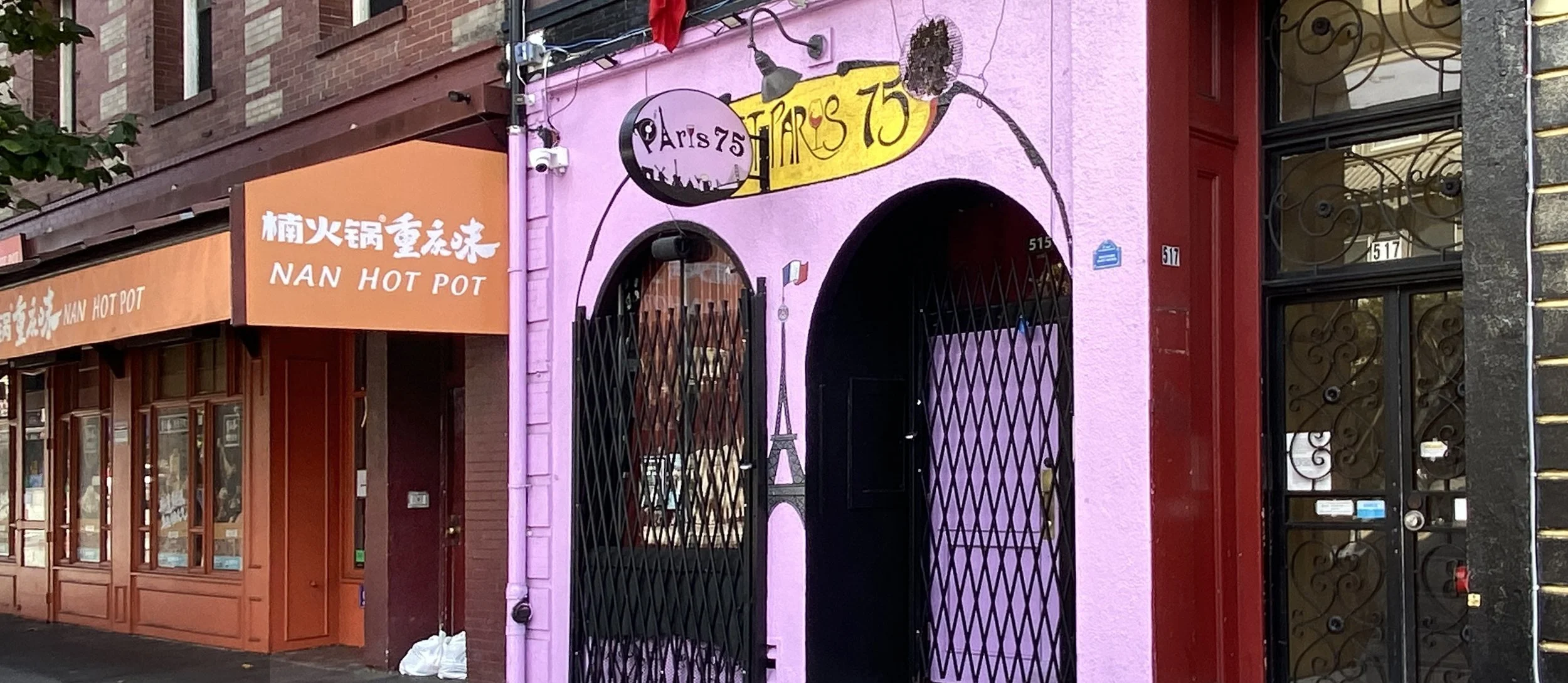
Then … They pass the Penthouse Cinema at 515 Broadway whose offerings include nude girls on stage plus a bonus: the adult porn movie The Devil In Miss Jones.. Next to it at left the Off Broadway stage entertainment club on the corner of Kearny Street trumpets its Lady Wrestlers show.
… and Now, today a French drinks and tapas lounge, Paris 75, occupies the cinema site while the Off Broadway has morphed into a Chinese restaurant offering Szechuan cuisine.
Here’s a vintage 1970s photo giving us another look at the Penthouse Cinema as it was back then.
… this photo of Off Broadway alongside the Penthouse Cinema was taken in 1980 a year or so after Time After Time was filmed.
Two blocks further down at 345 Broadway on the corner of Osgood Place Stevenson spots a girl dancing atop a pole outside Gorman’s Gay 60’s nightclub. The building in the background advertises its occupant, the Homestead Ravioli Company at 333 Broadway.
… In 1967 … in this vintage photo we can see how the dancer accessed the high perch. Behind her is the parking lot of Gorman’s club (the club itself was set back some from Broadway down Osgood). Note the line of lights to the right of the searchlight in the distance outlining the span of the Bay Bridge.
… and Now, an office building, currently for lease, has been built on that corner parking lot. The Bay Bridge is clearly seen from here.
… In 1964 … this earlier photo was taken of the parking lot and club with its original name of Gorman’s Gay 90’s. Osgood Place runs downhill on the right. Above and behind it are the US Appraisers Building on Sansome (center) and the Gateway Apartments on Battery (left).
… and Now, this recent photo of Osgood Place shows the building that replaced Gorman’s.
Then … The next day Amy drives to work, here passing a block-long brick building.
… and Now, she was approaching Larkin heading east on Beach Street past Ghirardelli Square in the Fisherman’s Wharf/ Aquatic Park neighborhood. Note the octagonal store in the upper left corner - we are about to get a closer look at it …
Then … As Amy turns into Larkin the camera pans up and zooms towards an elevated corner store selling women’s clothing where we see Stevenson turning on the charm with the pretty assistant. The barely legible window sign - it reads William Silva - led CitySleuth to its location; it was listed in the 1978 City directory as the William A. Silva Salon in Ghirardelli Square.
… and Now, the distinctively shaped building is still there, occupied since 2021 by Mexican restaurant Barrio.
She invites him to her place. Bad idea.
The swish of a blade and the deed is done. Once again director Nicholas Meyer chooses to show the consequence, not the gore.
Then … Taking advantage of his wife being away for the weekend Talbot invites Nora to take a trip with him to his family cabin. Flattered, she accepts; we see them leaving the city heading east on the upper deck of the Bay Bridge (filmed in the studio with rear projection footage).
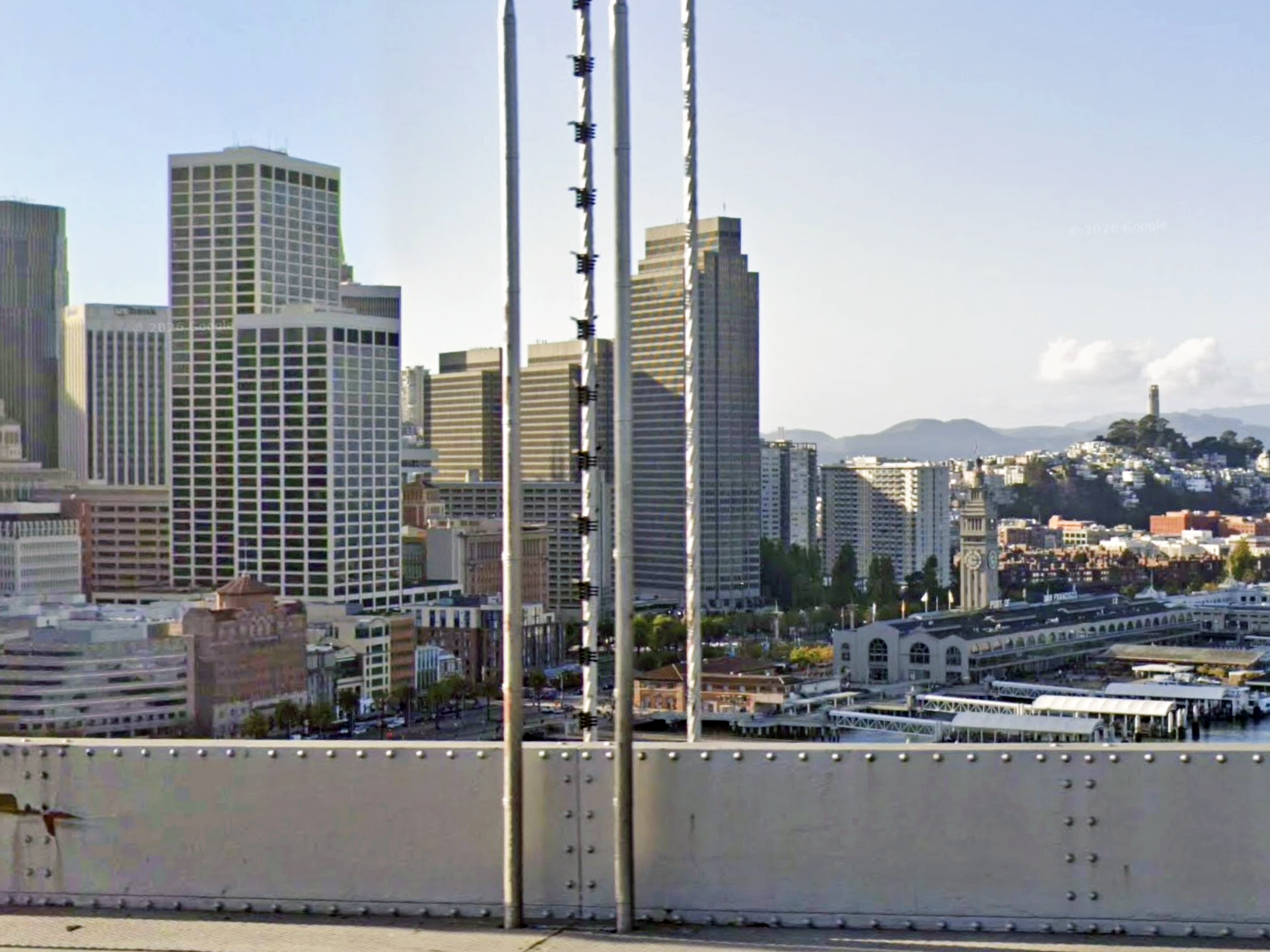
… and Now, this looks back towards San Francisco to the bridge’s first tower. Note that the upper deck is now one-way traffic into the city whereas back then it was two-way. Note too the Bay Bridge light display LED’s arrayed vertically on the right. More recently they have been added to the left side, resulting in a spectacular nighttime display on both sides of the bridge.
Then … in the distance looking to the north, Coit Tower is prominent at far right atop Telegraph Hill.
… and Now, here’s that view today; those high-rises were yet to be built back then.
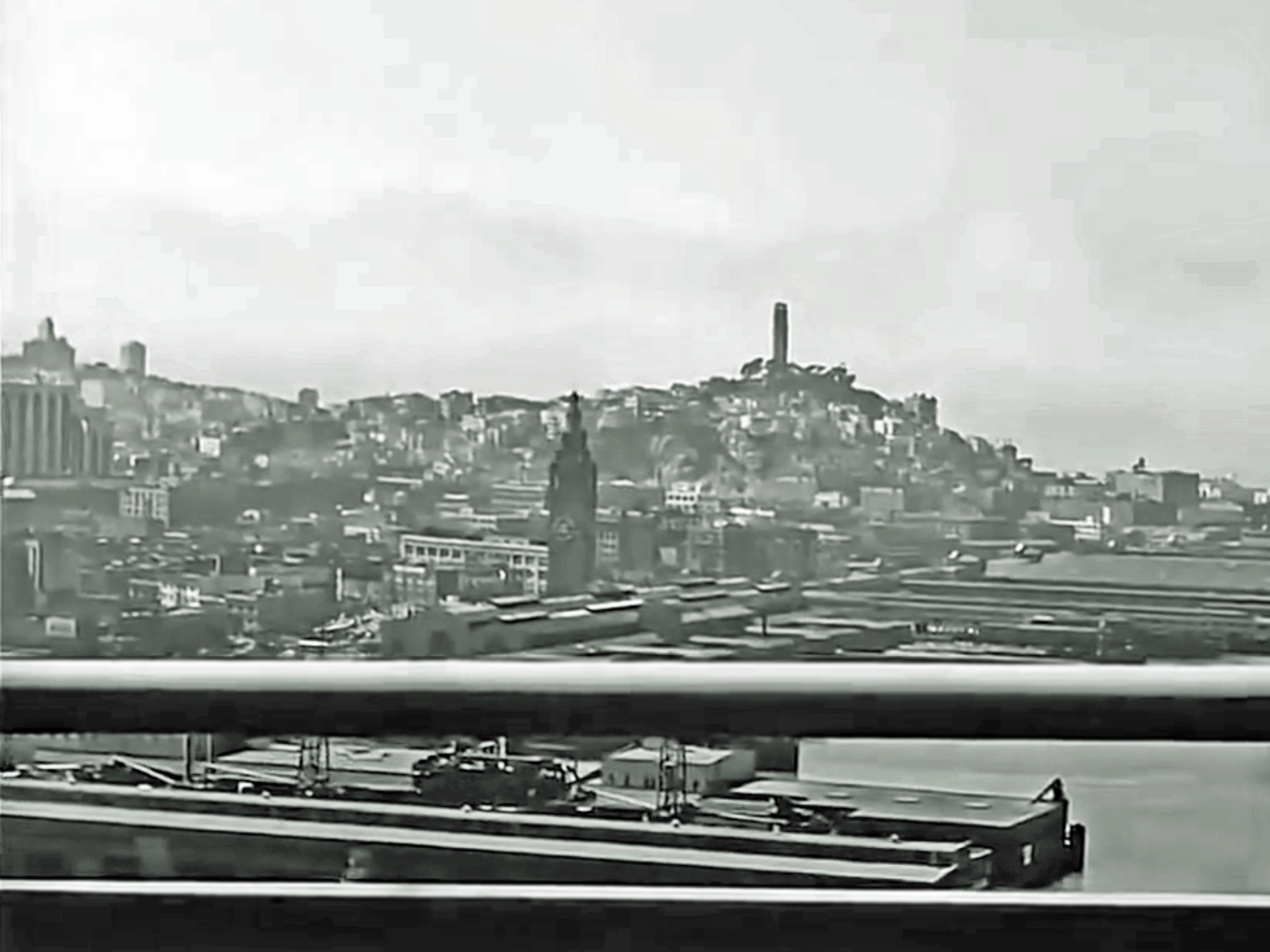
This contemporaneous capture from a 1940s video shows the view in more detail. The two buildings on the Russian Hill skyline at far left were visible between Nora and Talbot in the movie’s Then image above. The Ferry Building clock tower is in the center.
They arrive at the cabin in a scene almost certainly filmed at the studio’s back lot.
The shot can’t be duplicated so let’s talk about Talbot’s car instead. It’s a 1939 Plymouth Deluxe Convertible Coupe, pictured here in a photo from a classic car sale where it sold for $31,900. The seller claimed it belonged to MGM studios; if so it’s possible this particular car was borrowed by Warner Brothers for Talbot’s use in the movie. It’s fun to speculate from time to time.
In the cabin Nora begins to have qualms, tearfully questioning the wisdom of carrying on with a married man. But she yields to his passionate embrace and kiss.
Then … Talbot for his part has no qualms whatsoever; he’s head-over-heels with the lady. We next see him buying flowers for her in Union Square. The name on the window - Joseph’s Florist - and 1940s city directories revealed its address: 322 Post Street. Facing us across Union Square is the 200 block of Geary Street.
A 1940s vintage photo showed that same block as it appeared in the movie (outlined within the yellow box). Note the same rooftop billboard (blank at that time) and the white vertical Santa Fe Railway ticket office blade sign beyond the Dewey monument, both partially visible above. The iconic City of Paris Store is at far left.
… and Now, the same block today. Macy’s buildings have taken over half of the block and Nieman Marcus has replaced the City of Paris.
Another 1940s vintage photo captured Joseph’s Florist at 322 Post.
… and Now, this whole block has since been replaced except the Bullock and Jones building with its distinctive 3rd story triple arched windows; its most recent tenant, Williams-Sonoma, was there for over 20 years before closing down in early 2026. The yellow circle reveals where Joseph’s Florist used to be, overlapping the left end of today’s Apple Store.
Then … They head to Baker Street near Beach to admire the Palace of Fine Arts in the Marina district at the eastern edge of the Presidio.
… and Now, the Palace is the lone surviving structure at this site from the 1915 Panama-Pacific International Exposition. It continues to be a hugely popular visitor attraction.
Then … And why not pay a visit to Chinatown? Talbot may be enjoying himself now but he’s chosen a slippery slope and there’ll be no climbing back to normality for him from here. Like all of the restaurants back then Canton Low down the block at 708 Grant and the Far East Cafe further down across the street at 631 Grant down advertise chop suey, the dish of choice back then for visitors.
… and Now, they were on Grant Avenue; Commercial Street tees off to the left and Sacramento Street crosses behind them. Canton Low is gone, the Far East Cafe is still there but you won’t find chop suey on their menus thanks to pioneering restauranteur Johnny Kan who opened Kan’s restaurant in 1953 at the Canton Low site. Herb Caen at the time wrote … “A word of warning. Don’t ask for chop suey. The highest compliment to Kan’s conception of Chinese food is the absence of this most ersatz of Oriental dishes from his menu” . Foodie historians may want to read Johnny Kan’s interesting life story here.
Then … Amy takes Herbert to a movie at the Cinema at Ghirardelli Square at 901 Beach Street in the Marina District where he’s scared out of his wits by the violent action, the likes of which he has never seen before. Below, they have just exited the theater. The movie name is interesting, The most recent Exorcist movie back then then was Exorcist 2 … this was a dig by director Meyer at the Hollywood penchant for sequels (but years later he would himself co-write the sequels Star Trek II: The Wrath Of Khan and Star Trek IV: The Voyage Home.)
… And Now, the cinema is no longer there; the site now houses commercial offices.
This Dec 1974 photo shows the cinema as it was whenTime After Time was filmed - note the same Marquee sign. The preceding tenant in the building (it used to be an old Power House) was the Hungry-I nightclub which had moved there in the 1960s from its better-known North Beach location. The cinema opened in Aug 1971 but never did well, closing in Dec 1986. The movie entrance was the 3rd archway from the left; today that has been remodeled as a matching window and the entrance is now in the first archway on the left. On the right, Polk Street tees into Beach.
Then … They walk by a newspaper stand not noticing, but we do, the chilling headline … is Stevenson up to his old mayhem again? Behind the gawkers across the street is an interesting building …
… and Now, this is part of the ship-shape ship-shaped port-hole windowed Maritime Museum at Aquatic Park.
Then … By now Herbert is more than happy to tag along with Amy and when she invites him to her place for dinner he readily agrees. Her home happens to be in the Marina district across from the Palace of Fine Arts (we get to see it later in the movie) so on her way home after buying some food she introduces him to the grand edifice (although she bungles the facts a little, telling him it was built for the 1914 Pan American Exposition) …
… and Now, whereas in fact it was built for the 1915 Panama-Pacific International Exposition. It underwent an extensive rebuilding program from 1964 to 1974. This view looks across the lagoon from Bay Street near the corner with Baker Street. The fountain is still there!
This south-east facing enhanced vintage aerial photo shows the grand scale of the glorious exposition. The Palace, at lower right, is the sole on-site surviving structure. (There’s one other survivor, Firehouse No. 9, now called Firehouse No. 35, which was moved in 1915 to the Embarcadero next to Pier 22).
Then … She walks him through the Palace’s grand rotunda. Originally a wood and plaster structure, the replacement was built with steel and concrete.
… and Now, the Palace is exactly as it was other than an accumulation of grime but the Baker Street residences in the distance have undergone significant changes.
There’s nothing quite like an intimate dinner and a glass of wine to put one in the mood. He stays over and they do it.
But he is jolted out of his reverie by a radio news bulletin about a second North Beach brutal murder of a prostitute. Startled, he realizes who must be responsible.
Then … While Talbot’s wife is out of town for the weekend he impulsively drops by Dinardo’s, the nightclub where Nora sings. He’s seen here in Fisherman’s Wharf; behind him across the harbor are businesses along Jefferson Street with Coit Tower atop Telegraph Hill rising in the background. The neon-signed restaurant at 243 Jefferson Street directly below Coit Tower is DiMaggio’s Famous Restaurant, founded in 1937 by the five DiMaggio brothers.
This 1951 aerial photo shows where he was, circled - on a small bridge at the west end of the boardwalk in the center of the harbor. The white arrow indicates from where on the northern-most block of Jones Street (since renamed Al Scoma Way) the above movie scene was filmed.
Check out this 2015 photo matching the movie’s Then image above. It reveals a gap where the small bridge, an extension of the boardwalk that bisected the harbor, used to be - it was removed in 1960 to allow harbor access for larger fishing boats. DiMaggio’s, since moved upstairs to an added 2nd story, was still there after 78 years in business.
…and Now, the same view today. The gap where the bridge was is even wider now but the venerable DiMaggio’s has been replaced by the Supreme Crab restaurant.
DiMaggio’s distinctive neon sign was captured in this 1950s photo. Both it and the tall vertical sign are clearly seen in the movie image above.
…and Now, the same view today.
Then … Next he walks past steaming crab stands outside A. Sabella Fish Grotto (note at far right the movie’s cinematographer James Wong Howe in a cheeky cameo). Note too the restaurant’s neon blade sign mounted at 45 degrees on the corner. This is meant to be at 2770 Taylor Street at the junction with Jefferson where indeed A.Sabella, a real-world restaurant, was located but to CitySleuth this is clearly an impressive Warner Brothers back lot recreation.
… and Now, here’s the actual corner today where Applebee’s Restaurant now occupies the original upstairs A. Sabella space; the street level has been remodeled into retail shops.
Evidence pointing to a back lot location? Take a look at these two vintage photos of A. Sabella taken from different directions; the left photo from 1952 and the right one later in the 1950s. Note in both the corner blade sign like that in the Then image but the words were formatted differently. What’s more, the tiled street-level frontage didn’t match that in the movie.
He walks on, approaching the entrance on the right to Dinardo’s night club This is definitely a back lot location - it’s nothing like the 1940s Taylor Street block.
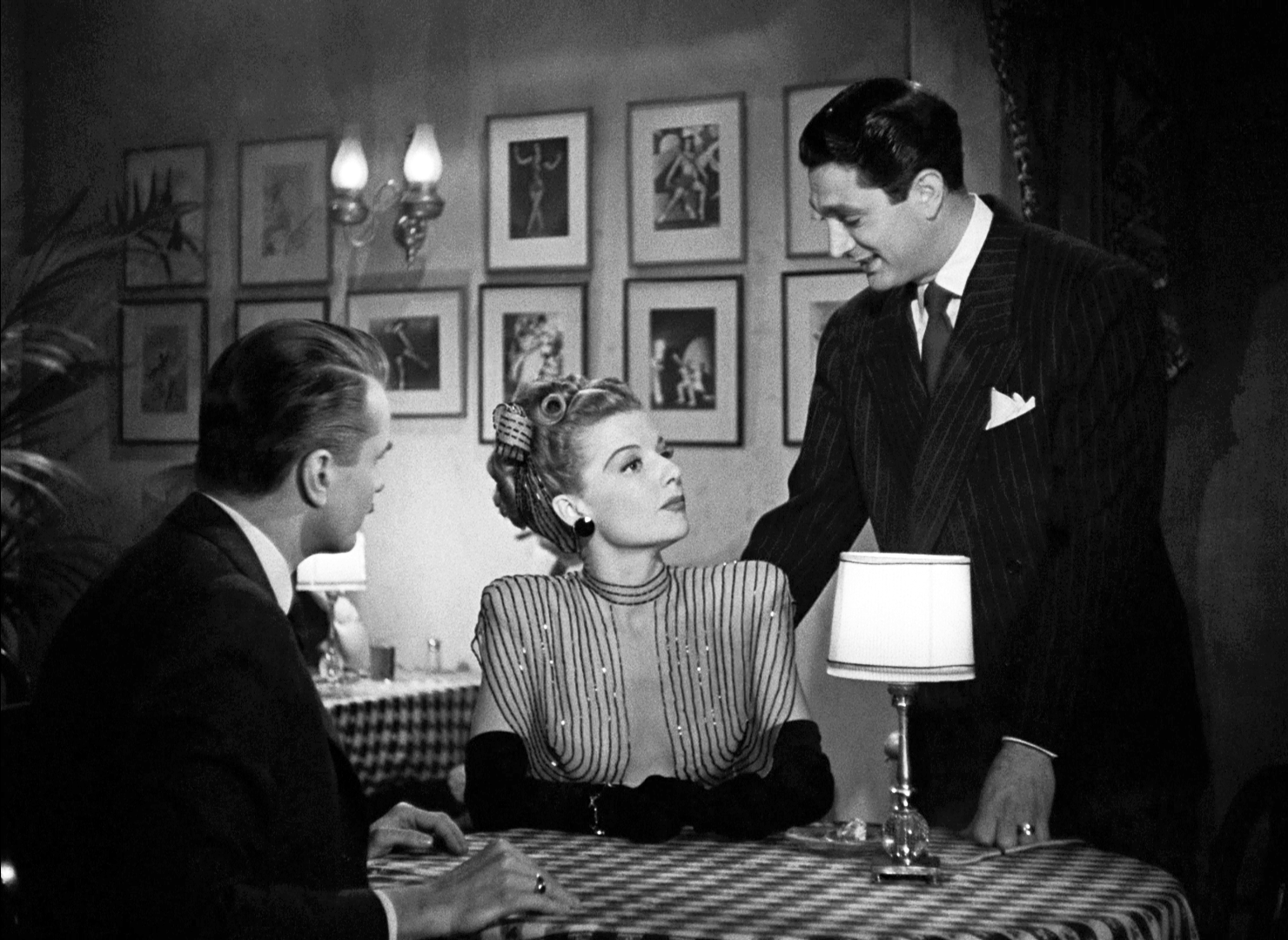
Inside, Talbot takes a seat at a table just as Nora, strikingly attired, begins her performance. Ann Sheridan herself sang this and another number in the movie.
Cigarette smoke, a sign of the times, adds to the ambience. This too was almost certainly filmed at the Warner Brothers studios.
After the song she joins Talbot. The club owner Phil Dinardo (Robert Alda, father of actor Alan Alda) has a thing for his star entertainer so he stops by, curious about who he is. Knowing he’s married, she discreetly comes up with another name for him.
On the set between takes the two stars were photographed at that same table with director Vincent Sherman.
And finally, let’s give credit to Nora Prentiss’s renowned cinematographer, James Wong Howe. His stellar career began in the Silent Movie era; he was finally awarded, below, the Best Cinematographer Oscar in 1956 for The Rose Tattoo (the first Asian American to win an Oscar). He went on to win a second in 1964 for Hud.