Then … While Talbot’s wife is out of town for the weekend he impulsively drops by Dinardo’s, the nightclub where Nora sings. He’s seen here in Fisherman’s Wharf; behind him across the harbor are businesses along Jefferson Street with Coit Tower atop Telegraph Hill rising in the background. The neon-signed restaurant at 243 Jefferson Street directly below Coit Tower is DiMaggio’s Famous Restaurant, founded in 1937 by the five DiMaggio brothers.
This 1951 aerial photo shows where he was, circled - on a small bridge at the west end of the boardwalk in the center of the harbor. The white arrow indicates from where on the northern-most block of Jones Street (since renamed Al Scoma Way) the above movie scene was filmed.
Check out this 2015 photo matching the movie’s Then image above. It reveals a gap where the small bridge, an extension of the boardwalk that bisected the harbor, used to be - it was removed in 1960 to allow harbor access for larger fishing boats. DiMaggio’s, since moved upstairs to an added 2nd story, was still there after 78 years in business.
…and Now, the same view today. The gap where the bridge was is even wider now but the venerable DiMaggio’s has been replaced by the Supreme Crab restaurant.
DiMaggio’s distinctive neon sign was captured in this 1950s photo. Both it and the tall vertical sign are clearly seen in the movie image above.
…and Now, the same view today.
Then … Next he walks past steaming crab stands outside A. Sabella Fish Grotto (note at far right the movie’s cinematographer James Wong Howe in a cheeky cameo). Note too the restaurant’s neon blade sign mounted at 45 degrees on the corner. This is meant to be at 2770 Taylor Street at the junction with Jefferson where indeed A.Sabella, a real-world restaurant, was located but to CitySleuth this is clearly an impressive Warner Brothers back lot recreation.
… and Now, here’s the actual corner today where Applebee’s Restaurant now occupies the original upstairs A. Sabella space; the street level has been remodeled into retail shops.
Evidence pointing to a back lot location? Take a look at these two vintage photos of A. Sabella taken from different directions; the left photo from 1952 and the right one later in the 1950s. Note in both the corner blade sign like that in the Then image but the words were formatted differently. What’s more, the tiled street-level frontage didn’t match that in the movie.
He walks on, approaching the entrance on the right to Dinardo’s night club This is definitely a back lot location - it’s nothing like the 1940s Taylor Street block.
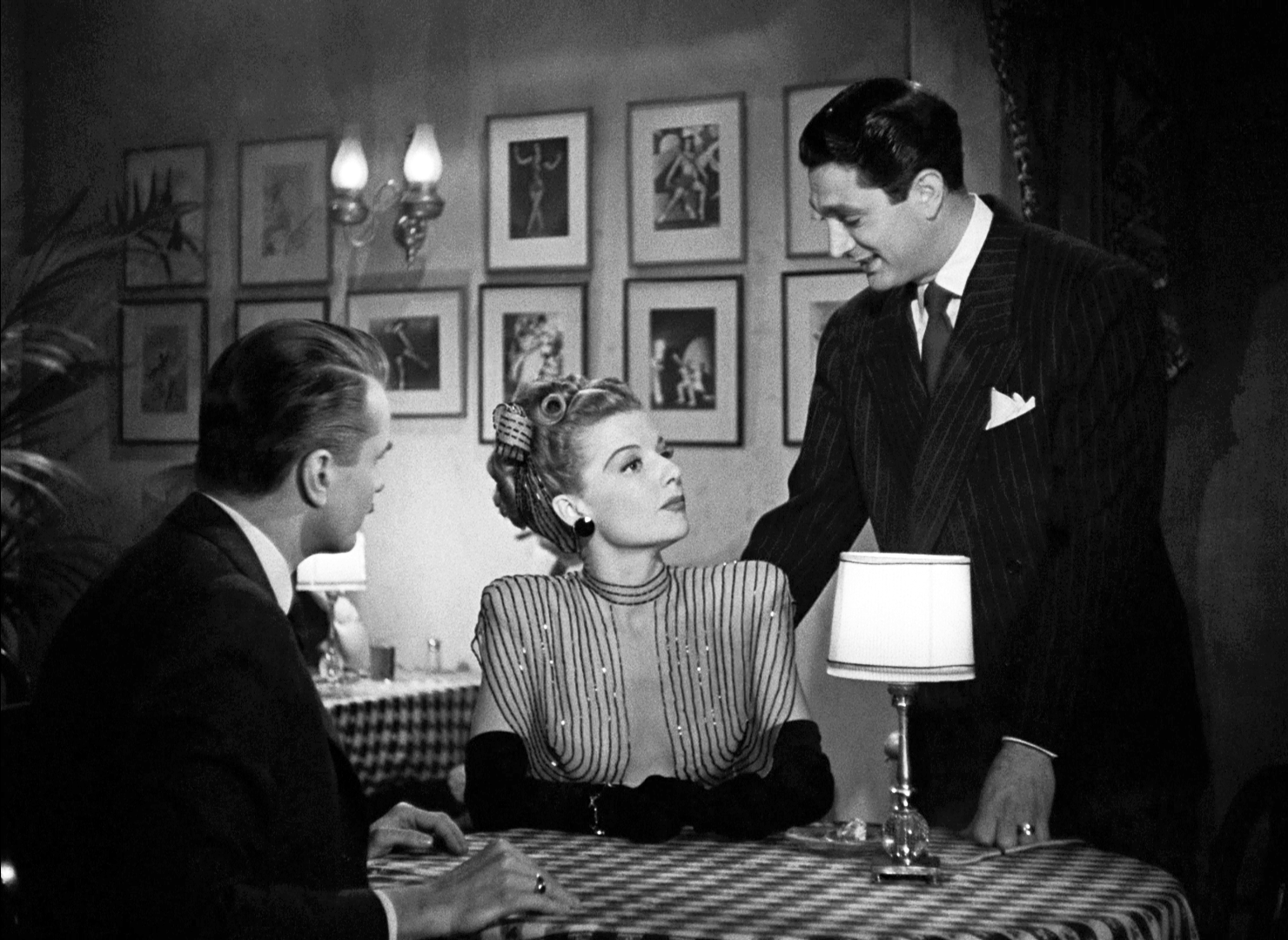
Inside, Talbot takes a seat at a table just as Nora, strikingly attired, begins her performance. Ann Sheridan herself sang this and another number in the movie.
Cigarette smoke, a sign of the times, adds to the ambience. This too was almost certainly filmed at the Warner Brothers studios.
After the song she joins Talbot. The club owner Phil Dinardo (Robert Alda, father of actor Alan Alda) has a thing for his star entertainer so he stops by, curious about who he is. Knowing he’s married, she discreetly comes up with another name for him.
On the set between takes the two stars were photographed at that same table with director Vincent Sherman.
And finally, let’s give credit to Nora Prentiss’s renowned cinematographer, James Wong Howe. His stellar career began in the Silent Movie era; he was finally awarded, below, the Best Cinematographer Oscar in 1956 for The Rose Tattoo (the first Asian American to win an Oscar). He went on to win a second in 1964 for Hud.
Then… Jo and Steve meet on the municipal pier at Aquatic Park (map), a place popular with local fishermen who enjoy the added bonus of great views in all directions. The 1400 foot-long circular pier was built in 1933; it has slowly deteriorated over the decades resulting in its recent closure to the public in 2022. That’s Pier 45 at Fisherman’s Wharf in the background at upper left, drawn in by the telephoto lens.
… and Now, the fishermen above were between the two lampposts below, near the far end of the sweeping breakwater pier. For the matching photos in this post Citysleuth found online images taken pre-closure. The cylindrical concrete structure seen ahead was meant to be a concessions stand complementing two similar ones on the shore at Aquatic Park but it never was completed.
Then… Steve wants to know why Jo refuses to go to the police about the stolen money. When Jo defends Chan, talking about his struggle to find his identity in America, Steve gets angry. In the background we see the liberty ship S.S. Jeremiah O’Brien berthed at Fort Mason, a rare survivor of the 2,710 liberty ships built to supply troops and critical materiel to Europe during WWII.
… and Now, The Jeremiah O’Brien was berthed here for many years but has since been moved to Pier 35. Note the decaying condition of the municipal pier’s concrete wall; note too the fence that was erected down the middle to exclude the public from this more dangerous seaward-facing half of the pier before it was finally closed completely.
This 1982 photo shows the Jeremiah O’Brien at its Fort Mason berth around the time Chan was filmed (compare it to the Then image above). It has been completely restored and is one of only two liberty ships still operational today. Interesting trivia - its engines were filmed for the engine room scenes in the movie Titanic.
Then… Steve lays into Jo, telling him there are no identity problems in the community any more. His voice rises … “What are you tripping on this sh-t for? The guy f-cked up man, he couldn’t cope with it”.
… and Now, in both photos we see an art deco building alongside the Aquatic Park beach at far left. Originally a bathhouse, it’s now a maritime museum.
… in 1948 … The pier and the bathhouse are seen here in 1948, nine years after the depression-era W.P.A-funded Aquatic Park project officially opened to the public (the aforementioned unfinished concessions stand is visible at the end of the pier). Designed to resemble an ocean-going ship the sleek streamline-moderne building provided swimmers with changing rooms and showers . At one time it also housed a private upscale restaurant and nightclub until outraged protests succeeded in shutting it down. Note the sidewalk waves lapping against the Beach Street entrance - a touch of whimsy.
… and Now, The bathhouse became a maritime museum right after troops who used the building during WWII handed it back. Hey, those waves are still there today!
Then… Steve gets increasingly agitated but Jo is adamant; he won’t report his friend to the police. They separate, backs turned.
… and Now, the Golden Gate bridge is but one of the many fine views from here. The pier wall was showing damage 40 plus years ago, above, but is far worse now, below.
Back at Chester’s Cafe they sit, wordless, Steve silently stewing. Chester’s was popular with workers from the cable car barn at the end of the block, some of them seen here in the background.
While looking at photos of fashion models at Jane’s studio George recognizes one of them; she was the nurse who had been on duty at his home the night Susan died. Knowing he is prime suspect number one in the police investigation and vehement in denying culpability, he realizes that finding her might help him.
Then … Jane wants to help George find the nurse. She meets her partner Larry at a photoshoot in the Japanese Tea Garden in Golden Gate Park (map). The Torri Gate is behind the model posing at the top of the steps and behind that, the multi-tiered Pagoda. At left is the Temple Gate.
… and Now, CitySleuth was disappointed on arrival to find the Pagoda undergoing renovation, wrapped in plastic. A couple of notable changes are apparent: the Temple Gate is now a taller structure following a renovation in 1985 after deterioration of the original and the Torri Gate is gone, having been removed to storage in 2001, also because of deterioration.
But no worries, here’s a 2012 image showing the Pagoda without the offending shroud. The gardens were immaculately kept back then before the pandemic shutdown.
Then … Knowing that Larry had hired the nurse she asks him if he can remember her name or how to get in touch with her. From here the Pagoda is viewed across an ornamental lake; the glimpse of red at far left is part of the Temple Gate.
… and Now, 53 years later here’s that same boulder Jane was resting against. Also the leaning tree trunk next to it.
Then … Elsewhere in Golden Gate Park, Larry (French actor Jean Sobieski) recalls only that the nurse was an occasional hooker on the side.
… and Now, they were a ten minute walk away at the Conservatory of Flowers (map), a botanical garden in a vast greenhouse thought to be inspired by the one in Royal Kew Gardens in Richmond, London. The Conservatory opened in 1879 and over the decades since then has survived two serious fires, years of inadequate maintenance and a devastating wind storm in 1995 that smashed 40 percent of its glass panes, necessitating an 8 year closure. A blessing in disguise because following a $25 million restoration it reopened in 2003 in the pristine condition seen here. Compare it to its shabby state above.
Then … Jane asks Larry to hire Monica to pose for a photo layout at her studio as a ruse to find out if she knows the nurse. He makes the call from a phone booth at Fisherman’s Wharf. (Check out his cool British sports car, a late 1960s Morgan Plus 4).
… and Now, the matching shot was taken from the Red & White Fleet terminal at Pier 43 1/2 (map). The yellow Fisherman’s Wharf circular sign so recognizable to tourists is seen in both Then and Now images.
Car buffs might enjoy this fine example of a 1968 Morgan +4 on display at a concours d’elegance - compare it with Larry’s.
Jane sets Monica up for the shoot in a steamy interaction between the two to the sexy strains of composer Riz Ortolani’s score. She has already found out from inquiries around the club circuit that the nurse’s name was Elizabeth O’Neill and that she was a dancer who had in the past worked with Monica.
But the erotica suddenly ends when Jane flashes an image of Elizabeth on a screen and George appears, offering to pay for information on her whereabouts. Monica, angry, would only say that she had left town some time ago.
Then … George decides he has to find out more about doppelgänger Monica West. Knowing only that she’s a high-class hooker he calls her from a phone booth at Hyde and Beach (map) to make an ‘appointment’. Behind him across the street was the 1907 Haslett Warehouse which together with the adjacent Cannery building once comprised the world's largest fruit cannery. Cannery operations ceased in 1939 but the building continued on as a warehouse.
… and Now, In 2002 the warehouse survived a fire that destroyed the interior while it was being converted to a hotel, the Argonaut. Undaunted, the hotel opened in 2003 and is still in business there today. The phone booths (there were two) are no longer there.
Then … He walks to his Corvette parked at the Hyde Street cable car terminus. The view looks across Aquatic Park Cove towards the Golden Gate Bridge and the Marin County hills.
… and Now, The city’s cable car system underwent a $60M safety rebuild from 1982 - 1984 including a re-positioning of the Hyde Street terminus turntable and its approach tracks. In today’s matching view the bridge is obscured but Sausalito’s hillside houses are still visible on the right as also seen above.
As he turns into Hyde he passes the telephone booths from where he had made the phone call. That’s the Hyde Street pier entrance straight ahead on Jefferson Street at the bottom of Hyde.
Then … As the Corvette crosses Beach Street the insurance agent tailing George leaps into his 1969 Ford Galaxie 500 parked on the corner. Leslie Salt Company’s San Francisco headquarters at 505 Beach Street is seen down the block.
… and Now, Here’s today’s view; Leslie Salt Co. is no longer in business.
On a trivia note, Leslie harvested its salt from evaporative salt ponds located around the south bay shoreline, storing it as massive salt mountains near the Redwood City Marina, pictured here in 1977. Leslie was bought by the Cargill Company in 1978; they ceased production here in 2006 after which the mountain was sold by degrees until it was gone for good.
Then … the agent follows George up Hyde Street giving us a glimpse of the tourist favorite Buena Vista Cafe at 2765 Hyde.
… and Now, The cafe/bar is still there and as popular as ever. It dates back to 1916 when it was a saloon but it was only after 1952 when the owner had a light-bulb moment that his establishment became a cash cow.
… that’s when he formulated and introduced the “perfect Irish Coffee”, a mellifluous blend of sugar, coffee, Irish whiskey and cream (added in that order). Millions of grateful palates have over the years marveled at how its primeval warmth counters the city’s chill with each salubrious sip.